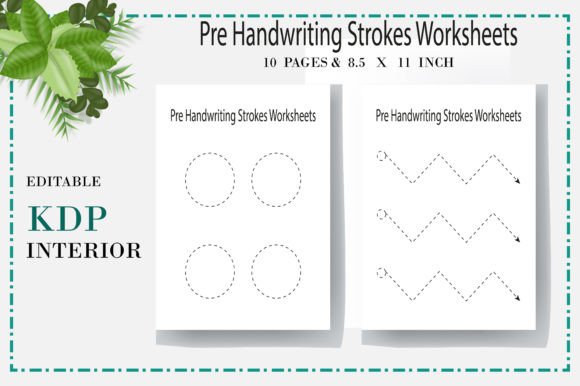
Pre Handwriting Strokes Worksheets – 10 Pages of Purposeful Penmanship Practice
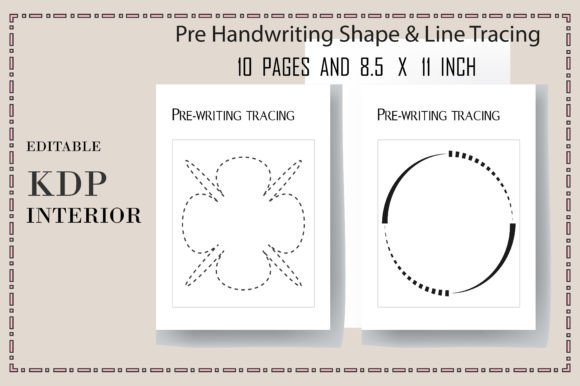
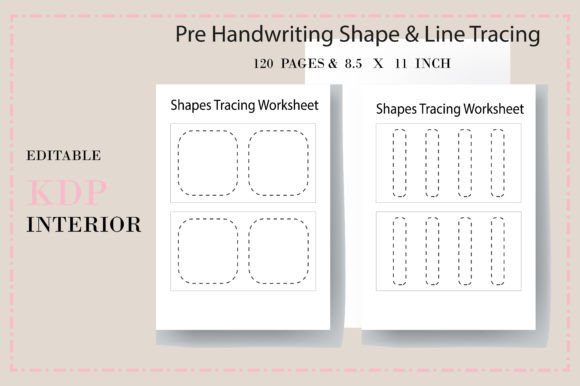
Before a child writes a single letter, their hand needs to master a set of fundamental movements. Vertical lines, horizontal strokes, circles, slanted lines, and crosses might look like simple doodles, but they are the building blocks every lowercase and uppercase letter relies on. The Pre Handwriting Strokes Worksheets offer a practical, ready-to-use way to turn those first wobbly attempts into confident, controlled marks. The set includes 10 worksheets designed exactly for that transitional stage between picking up a crayon and writing a name.
Unlike a generic coloring page, these worksheets zero in on isolated strokes in a clean, distraction-free layout. Each page gives the learner multiple repetitions of the same stroke path, starting with large directional arrows and gradually reducing guidance. That repetition builds muscle memory. This matters whether you are a teacher trying to fit in targeted motor practice before a literacy block, a parent wanting to help a restless preschooler channel energy into a quiet activity, or an occupational therapist searching for a resource you can adapt on the fly.
The Missing Link Between Scribbling and Letter Formation
Many early writing struggles are not about letter recognition. They are about motor coordination. A child might know what an "A" looks like but cannot draw the two diagonal lines that meet at a precise point. The Pre Handwriting Strokes Worksheets address this exact gap. By isolating the strokes—long vertical lines that build into the stems of b, d, h; counterclockwise circles that lead into a, c, o; zig-zags that pave the way for k, v, z—the learner focuses entirely on the movement instead of the symbol. This separation reduces frustration. It lets a nervous four-year-old succeed at a "lion's mane" tracing loop without worrying about the letter L. Once that physical confidence grows, connecting the stroke to an actual letter feels natural, not overwhelming.
Where Do These Worksheets Fit Into Real-Life Routines?
Because the set is delivered as both an instantly printable PDF and an editable AI source file, the same 10 pages adapt to spaces as different as a sunny kitchen table and a bustling therapy clinic. The standard 8.5″ x 11″ dimensions with no bleed mean you never have to trim strange borders or adjust printer settings in a rush. Just download, print, and go.
A Classroom Morning Work Staple
Between collecting permission slips, taking attendance, and speaking with a parent at the door, the first ten minutes of a school day can vanish in a blur. Teachers who slip one of these Pre Handwriting Strokes Worksheets into a morning work routine buy themselves a pocket of calm. Students settle at their desks, pick up a pencil or a thick marker, and slip into focused tracing. There is no confusing multi-step direction to explain. The page layout is intuitive, so even children who are not yet reading can follow the dotted guides. Over a week, a teacher might use the circle page to prepare learners for upcoming lowercase "c" and "a" practice without ever mentioning letters. The quick, visible improvement in pencil grip and line smoothness becomes informal data you can note while walking the room.
Quick Skill Checks and Evaluation Tools
Formal handwriting screeners have their place, but a responsive teacher often needs a five-minute snapshot of how a child handles a writing tool. The 10 worksheets function as lightweight probes. Hand a child the page with intersecting lines and observe: do they start at the top? Do they reverse the direction unintentionally? Is there tremor or excessive pressure? The committed repetition of a single stroke shows you more than a worksheet with mixed letters ever could. Many educators use one page as a warm-up before a writing assessment, then note changes in endurance or confidence. Because the file is editable in AI, you can even add a small box at the bottom for notes, date stamps, or a simple smiley scale, creating a custom tracking sheet without starting from scratch.
At-Home Reinforcement and Rainy Day Activities
A parent stuck indoors with a high-energy preschooler does not always need elaborate sensory bins. Printing two sheets from the PDF—say the curvy wave lines and the sharp zig-zags—and sliding them into clear sheet protectors converts them into reusable dry-erase boards. Children draw with a low-odor marker, wipe, and repeat. The 10-page length feels manageable rather than overwhelming; a child can complete one or two without hitting the fatigue that triggers a meltdown. For families who follow a relaxed homeschool rhythm, having the Pre Handwriting Strokes Worksheets on standby means a quick living room lesson can pivot naturally from a read-aloud about weather to tracing "rain streaks" (slanted lines) that will later become letters like R and N.
Occupational Therapy Sessions and Specialized Support
Pediatric occupational therapists rarely find off-the-shelf materials that fit every child on a caseload. One learner might need thickened stroke paths because of low vision; another may need the starting dot moved to the right side to accommodate left-hand dominant crossing patterns. The editable source AI file removes the barrier. You can open the file in Adobe Illustrator, increase the stroke weight of the tracing guides, add colored start dots, or stretch the patterns over a larger area of the page. The no-bleed design also means that when you send the modified sheet home, the family prints it on standard paper without fragmented edges. A therapist can progressively increase the challenge by changing the opacity of the guide lines over several sessions, using the same base file. That kind of flexibility, paired with the targeted stroke practice, often translates into more measurable fine motor gains.
Why a 10-Page Editable Set Changes the Game
Many printable resources lock you into exactly what the designer created. While a beautiful font is nice, practicality wins. The fact that this resource arrives as a high-quality PDF and an AI file means you are not renting the content; you are equipped to mold it. This matters in very tangible ways.
Imagine an early childhood center adopting a new literacy curriculum that introduces a slightly different stroke progression. Instead of discarding existing resources, the center director can open the AI file, reorder the pages, adjust the dashed line lengths to match the new scope and sequence, and save a fresh PDF for the entire teaching team. The 10 pages provide a clean progression—usually moving from large, slow strokes to tighter, more refined ones—so the foundation is already solid. Just minor tweaks make it seamlessly fit any program.
From a pure printing standpoint, the 8.5″ x 11″ size with no bleed eliminates an annoying friction point. Anyone who has printed a teaching resource only to find a thin white border or a chopped-off edge knows the frustration. These pages print edge-to-edge on a standard letter-size sheet. You can hole-punch them for binders, use them in literacy centers without trimming, or photocopy them in bulk for a whole grade level without checking "fit to page" a dozen times.
Who Benefits the Most? Real Scenarios
Different users pull different value from the same file. This adaptability is what transforms a static worksheet into a versatile tool.
The Multi-Grade Elementary Teacher
A first-grade teacher handling both struggling writers and advanced kindergartners might use the editable file to insert tiny uppercase letters next to each stroke, showing the connection explicitly. For a second-grade student who still reverses diagonal strokes in letters like M and W, the teacher prints just the diagonal line page on heavier cardstock and laminates it. The child traces with a finger during snack break. There is no stigma—because the worksheet doesn't scream "review," it just looks like a pattern game. Teachers report that when the task feels playful rather than remedial, resistance drops and stamina builds faster.
The Homeschooling Parent on a Budget
Ten pages may sound modest, but for a homeschooling family teaching several children across different developmental windows, a one-time purchase yields years of use. The PDF prints as many times as needed within the household. Today, the five-year-old traces circles in red marker. In two years, the three-year-old colors inside the same lines with chunky crayons. Keeping the master file backed up means no wear and tear matters. The editable AI feature also allows a crafty parent to color-code each child's set—blue strokes for one, green for another—minimizing conflict over "my paper."
The Educational Content Creator or Small Business Owner
Coaches, curriculum developers, and niche bloggers often need high-quality starter templates to build proprietary resources. The AI source file serves as a time-saving backbone. You can extract the stroke designs, drop them into a larger workbook, adjust colors to match a brand palette, or add themed illustrations. While individual licensing terms should be reviewed, the baseline flexibility significantly reduces the grunt work of drawing each stroke from scratch. A creator developing a woodland-themed pre-writing pack can wrap the same reliable circle tracing pattern in a mushroom or acorn border without redesigning the core motor path, which maintains both consistency and speed.
The Grandparent or Caregiver Guiding Early Learning
Not every early childhood mentor is a trained educator. A grandparent who watches a preschooler twice a week can feel unsure about how to "teach" writing. The Pre Handwriting Strokes Worksheets remove the guesswork. The ordered, repetitive layout offers gentle structure. Simply printing the PDF and sitting side by side with a snack creates a low-pressure ritual. The caregiver can point to the directional arrow, say "let's follow the path," and model the motion. Because the pages require minimal explanation, the adult feels successful, and the child gets quality one-on-one interaction that naturally builds fine motor skills.
What to Look for When Choosing Pre-Writing Worksheets
Not all tracing pages create equal learning. Before downloading any set—including this one—consider what makes a line practice sheet actually work for developing hands.
Stroke weight and clarity. Thin, delicate tracing lines look pretty on a screen but frustrate a child whose hand still moves in jerks. The Pre Handwriting Strokes Worksheets are designed with generous dashed guides, so a learner can stay inside the line with a workable margin. This matters enormously for kids developing a proper pencil grip; too thin a path encourages a tight, cramped hold that leads to fatigue.
Progression, not randomness. Effective worksheets start with broad, vertical strokes that require larger whole-arm movement before asking for the small wrist rotations needed for tight zig-zags. The 10-page set typically follows such a sequence—you will see horizontal lines, circles, and simple diagonals before more complex combinations. This scaffolded approach builds motor planning and confidence simultaneously.
Practical printing specs. Check the dimensions and bleed. A file meant for A4 paper printed on US letter size forces awkward cropping. The 8.5″ x 11″ size and no-bleed guarantee that this set integrates into the most common North American printer and binder setups without extra steps. That may sound trivial, but anyone managing a classroom or a roaming cart knows seconds matter on a Monday morning.
Editability and future use. Even if you do not think you will modify a worksheet, life changes. One year you might teach a child with high sensory needs who benefits from thicker borders; the next you might run a parent workshop and want to add a short instructional header. The AI file gives you that option without hunting for the original creator or paying again.
Simple Ways to Extend the Life of Your 10 Pages
Stretching a resource multiplies its value. Users typically discover that these pages go far beyond a single pencil-and-paper session.
- Slide and dry erase. Place the sheet in a heavy-duty page protector or laminate it. Trace with a fine-tip dry erase marker. Wipe with a cloth. This turns one page into a dozen uses.
- Multisensory tracing. Spread a thin layer of sand, shaving cream, or salt on a tray. Use the printed worksheet as a reference card. The learner replicates the same stroke pattern with a finger in the sensory material before ever holding a marker.
- Rainbow writing. Have the student trace the same stroke multiple times using a different color each round. The layered effect shows them exactly where their path is drifting, and it builds deliberate motor control rather than mindless repetition.
- Vertical surface practice. Tape the worksheet to a wall, easel, or refrigerator. Working on a vertical plane naturally extends the wrist and encourages proper shoulder stabilization. The large 8.5″ x 11″ sheet is big enough to trace while standing yet not so large that the arm tires quickly.
A Thoughtful Addition to Any Early Writing Toolbox
There is a quiet power in having exactly what you need when a teachable moment shows up. The Pre Handwriting Strokes Worksheets sit in a folder on your desktop, equally ready for a frantic Monday morning or a relaxed Sunday afternoon. The 10 pages are not padded with filler; each one serves a clear motor skill purpose. The instantly usable PDF gets you through today, while the editable AI source file morphs into whatever you need tomorrow. That blend of immediate practicality and long-term flexibility is what makes the set feel less like a disposable handout and more like a lasting teaching partner. For families, classrooms, and clinics aiming to build handwriting readiness without burnout, these worksheets earn their digital space rather than clutter it.