Golf Logbook KDP Interior: A Ready-to-Use Solution for Publishing Your Golf Journal
Creating a printable golf logbook from scratch feels a lot like trying to read a putt with your eyes closed. You can guess at the dimensions, gamble on the margins, and hope the pages line up, but the result rarely looks professional. That is exactly why a premade Golf Logbook KDP Interior exists—it hands you a complete, tested layout so you can move straight to publishing on Amazon KDP or any print-on-demand platform. Whether you want to sell a golf score tracker, create a coaching resource, or build a branded giveaway for a tournament, having files that are already sized, formatted, and bleed-ready removes the technical guesswork.
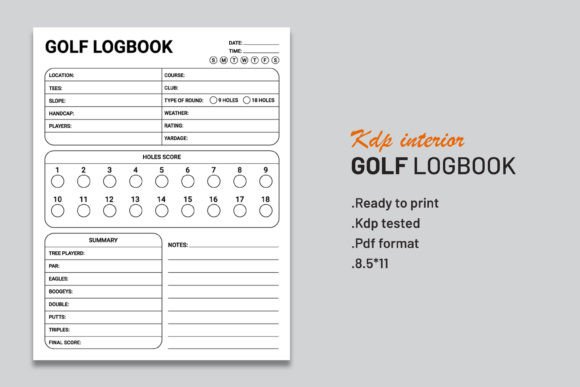
But this interior is more than a time-saver. The structure has been specifically built for people who understand that a book needs to feel right in the hands. The 120-page count gives it substance without being bulky. The 8.5 x 11-inch trim size makes it large enough to record detailed round notes, course conditions, and swing reflections, yet it still fits easily into a golf bag side pocket. And because the files are provided in multiple formats—editable AI, high-res PDF, and PNG—you can adapt the interior to your own brand or simply upload it as is.
Who Actually Needs a Predesigned Golf Logbook Interior?
At first glance, you might assume this is only for KDP publishers who churn out low-content books. But the people who get the most value from a Golf Logbook KDP Interior are often far more hands-on. A golf instructor, for example, might want to give every student a consistent practice journal. Instead of photocopying crumpled scorecards, they can publish a polished book with their logo on the intro page and hand it out during the first lesson. The editable AI file makes that kind of personalization straightforward.
A tournament organizer planning a charity event could use the same interior to create a commemorative logbook for each participant. Rather than paying a designer from scratch, they download the files, add the event name and sponsor logos to the intro page, and upload a unique edition to KDP. Within days, they have a printed keepsake that goes beyond a generic trophy. In both cases, the interior solves a real-world need: turning a simple idea into a tangible product without hiring a layout specialist.
Even solo golfers find uses for these interiors. Someone who plays at a different course every weekend and wants to track more than just the number on the scorecard might publish their own custom version. They get the satisfaction of designing the cover, setting the page prompts, and holding a book that matches exactly how they think about the game. The process becomes part of the enjoyment, not a barrier.
Real-World Scenarios Where a Golf Scorekeeper Journal Shines
Think about the times when a golf logbook becomes more than a notebook. A retiree planning a bucket-list trip to Scotland might use the interior to create a travel journal dedicated solely to links courses. They add a few custom pages at the beginning to map out the itinerary, then use the bulk of the 120 pages to document each round. The high-resolution PDF ensures that when it prints, the crisp lines and subtle golf-themed details look deliberate, not pixelated.
A junior golf academy operating across multiple locations needs a uniform way to track player development. Coaches can take the Golf Logbook KDP Interior, adjust the intro page to include the academy’s core values, and produce a branded development journal for every student. Because Amazon KDP makes ordering author copies affordable, the academy can keep a steady supply without managing inventory or dealing with a local printer.
Meanwhile, a blogger who writes about course reviews and equipment tests might use the interior as a lead magnet. They add their website URL to the footer or intro page, publish a limited version as a free PDF download through their email list, and build a subscriber base while giving away something genuinely useful. The PNG files let them create social media mockups that look polished, even before they order a single proof copy.
What Makes This Interior Different from Starting from Scratch
If you have ever stared at a blank InDesign or Canva document trying to set up facing pages, inside margins, and bleed zones, you know the quiet frustration. KDP interior specifications are not forgiving. For a book with 120 pages, a fraction of an inch error in the gutter margin can make text disappear into the binding. What sets this product apart is that it has already survived that learning curve. The note "KDP tested" means someone has uploaded this exact file to Amazon, ordered a proof, and verified that the pages fall exactly where they should.
Being bleed-ready is another underappreciated detail. An interior with bleed means the design extends to the edge of the page, so when the paper is trimmed, there are no white slivers along the borders. For a golf logbook, this matters if you include any background patterns, header bands, or bordered tables. Without bleed, those elements would look amateurish. The included files already account for this, so you do not need to calculate extra bleed margins yourself.
The combination of file types also gives you flexibility most free templates lack. The editable AI file lets you change fonts, move elements, or add new sections entirely. The PDF is your ready-to-upload, print-ready version. The PNGs are ideal for previews, listing images, or assembling a quick look book before you commit to publishing. You are not locked into a single way of working.
How Different Users Personalize the Same Interior
Variety comes from how people adapt the foundation. A mindfulness coach who blends golf with mental focus exercises might take the AI file and insert breathing prompts before every nine-hole score section. The layout remains intact, but the purpose shifts entirely. The same 120-page structure that works for a traditional scorekeeper now becomes a wellness tool.
A father teaching his daughter the game could swap the standard intro page for a dedication and a few rules of etiquette. The rest of the logbook stays simple: date, course, par, score, notes. The beauty is that the family publishes their own edition, one that feels uniquely theirs, using a backbone that did not require their time to engineer. The cost per copy stays low because they are only paying for printing and KDP’s royalty deduction, not a designer’s hours.
A small business selling golf-themed gift sets on Etsy finds a different angle. They bundle a custom-covered golf journal with a set of personalized balls and a divot tool. Because they can quickly upload a new cover design each season while keeping the interior consistent, their product line feels fresh without relaunching the entire project. The Golf Logbook KDP Interior becomes a reusable asset, not a one-off project.
What to Check Before You Publish Your Golf Logbook
Even with a done-for-you interior, a few practical checks make the difference between a book you are proud of and one that triggers a return. First, open the editable AI file and verify that the intro page placeholder text actually gets replaced. It is easy to overlook, and customers notice when a book starts with “YOUR TITLE HERE” in elegant script. The file is easy to edit, but that step is yours alone.
Second, remember that while the interior is ready for 120 pages, your content must fill those pages meaningfully. If you plan to create a guided journal, think through the prompts you add. A player who opens the book to find the same two questions repeated for every round might not feel motivated to keep using it. Mix in some variety: a course sketch space, a weather condition box, a reflection on the best shot of the day. The interior provides the container; you provide the experience.
Third, order a proof copy. Any Amazon Kindle Direct Publishing interior, no matter how well tested, can look different on paper than on screen. Check the bleed, the ink density, and the overall feel. Flip through all 120 pages to make sure nothing shifted during the upload. The time spent on a proof saves the headache of a poor review later.
Finally, think about your audience’s expectations. A golfer who plays once a year might be happy with a simple score grid, while a serious amateur might want space for club selection notes, fairway hit percentages, and putting tempo thoughts. Tailor the intro and any adjustable elements toward the reader you have in mind. The interior can serve both, but your branding and added text signal who the book is for.
Why Publishers Keep Returning to Predesigned Interiors
There is a quiet efficiency that comes from using a product designed specifically for KDP. When you bypass the layout stage, you can go from idea to listing in a single afternoon. A creative entrepreneur testing a new niche—say, golf fitness tracking—does not want to invest days in formatting before knowing if there is demand. By using the Golf Logbook KDP Interior, they can launch quickly, gauge interest, and only refine further if sales validate the concept.
Seasoned publishers also appreciate that the interior comes with an intro page already designed. That tiny detail means the book opens with a polished first impression, even if you change nothing else. Customers flipping through the “Look Inside” feature on Amazon will see a clean, intentional layout rather than bare pages. Trust builds in those first few seconds, and a tested interior earns that trust on your behalf.
The 8.5 x 11-inch format also aligns with what many low-content buyers expect for logbooks and journals. It gives ample writing space without being an oversized novelty. Because the dimensions are standard, the book fits neatly onto bookshelves and stacks well if a pro shop wants to display multiple copies. Every design decision baked into the product supports a smooth customer experience.
Bringing a Professional Golf Journal to Market Without the Stress
In the end, a Golf Logbook KDP Interior represents a shortcut to credibility. It takes the parts of self-publishing that often frustrate creative people—margin calculations, file types, trim compatibility—and turns them into a solved problem. You still bring the vision, the cover design, and the understanding of what golfers want to record. But the technical backbone stands ready to support whatever direction you take.
Whether you are a first-time publisher curious about the golf niche or a seasoned creator looking to add a proven journal to your catalog, having these files reduces the friction between idea and income. And each time someone opens that journal on the first tee, jots down their goals, and tracks their progress across 120 pages, they are holding something that started with a straightforward decision: to use a solid foundation instead of building from the ground up.