Hotel Reservation Log Book KDP Interior Template
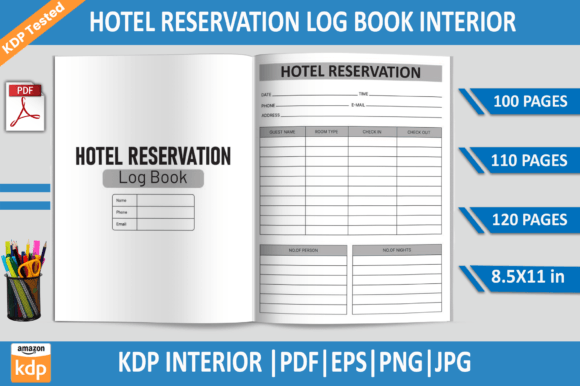
If you have ever tried to launch a print-on-demand journal on Amazon, you know that the interior file can make or break the project. A clean, tested, and instantly downloadable interior gives you a huge head start. The Hotel Reservation Log Book KDP interior template does exactly that. It is a ready-to-upload collection of files designed specifically for a hotel reservation record book, purpose-built for Kindle Direct Publishing. Instead of wrestling with margins, line weights, or KDP’s print checks, you get a production-ready package that includes multiple page counts, editable vector files, and high-resolution raster formats.
What makes this package stand out is the combination of immediate usefulness and creative flexibility. Beginners can grab the print-ready PDF and have a live listing within minutes. Experienced publishers and designers can take the EPS file and transform the template into a fully branded product for a client, a boutique hotel chain, or their own publishing brand. It removes the technical friction while keeping the door open for customization.
A Closer Look at What You Get
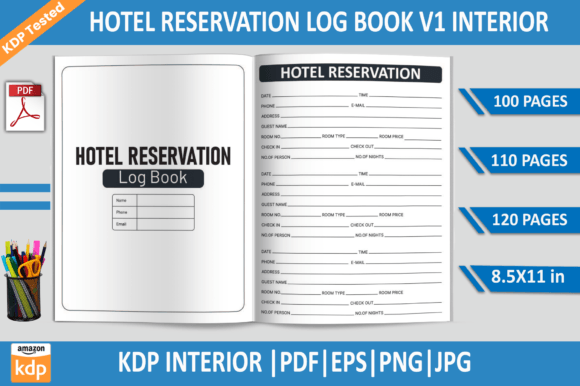
Every download comes with a thoughtfully organized set of files. You receive three print-ready PDF versions with 100, 110, and 120 pages. This gives you the freedom to choose a page count that matches your desired trim size, spine width, or pricing strategy without reformatting anything. Alongside the PDFs, the package includes an EPS file, a transparent background PNG, and a high-resolution JPG file. All artwork is set up at a crisp 300 DPI, sized precisely to 8.5×11 inches, with no bleed required. The files have been tested on Amazon KDP, which means you can skip the guesswork and worry less about unexpected rejection emails.
Who Can Benefit from a Specialized Reservation Log Interior
The people who search for a hotel reservation log book interior come from very different backgrounds, and their reasons for valuing a premade template vary just as much. A self-publishing beginner might see it as a low-risk way to enter the KDP game with a niche product that already has proven search demand. An experienced KDP seller might view it as a logical expansion of their existing line of log books, guest registration books, or vacation rental journals. A graphic designer or studio owner might treat the EPS file as a structured starting point for a custom commission, saving hours of layout work.
Small business owners in hospitality also find unexpected value here. A bed-and-breakfast owner who wants to offer a branded reservation tracker for sale at the front desk can work with a designer to adapt the template without paying for a full custom layout from scratch. Similarly, an entrepreneur creating a print-on-demand store around travel and lodging accessories can add this log book to their catalog in a single afternoon. Because the template comes in both flat raster and fully editable vector formats, it accommodates users who need zero-touch uploads just as smoothly as those who plan to tweak every element.
Ease of Use for the First-Time Publisher
If you are new to KDP, your biggest concerns are often about technical hurdles. Will the file pass the automated review? Did I set the margins correctly? Why does my PDF look perfect on screen but generate errors on Amazon? The 100 tested label on this template directly addresses those fears. The PDF files are built to match the KDP print specifications exactly, including safe zones, minimum margins, and proper page ordering. You download the PDF that matches the page count you want, upload it while setting up your paperback listing, and publish. The process feels closer to filling in metadata and a cover rather than wrestling with design software.
Moreover, because the theme is so specific, you sidestep the analysis paralysis that often comes with overly generic notebook interiors. A hotel reservation log has an expected structure—spaces for guest names, check-in and check-out dates, room numbers, contact details, and special requests. This template already incorporates those logical sections, so you are selling something that buyers instantly recognize as useful and practical, not just a plain lined notebook pretending to be a log book.
Why Experienced Publishers Appreciate the Editable Formats
Veteran KDP sellers often have established brand colors, typography systems, and cross-promotional strategies. For them, the value lies less in the plug-and-play PDF and more in the editable EPS file. They can open the vector file in Adobe Illustrator or a compatible program, swap out fonts, integrate a logo, adjust the table styles, or even extract individual page elements to use in a whole series of products. The transparent background PNG makes it easy to overlay elements on cover designs or marketing graphics without a white box ruining the composition.
This level of control also matters when you want to upsell or bundle. You could take the 100-page version, lightly customize it, and sell it as a compact edition, while using the 120-page version as a deluxe offering. Having multiple page counts already prepared saves you from repeatedly exporting and checking new PDFs. It effectively multiplies your product line with minimal extra effort.
Quality and Reliability from a Professional Standpoint
If you are a coach or educator teaching print-on-demand strategies, the Hotel Reservation Log Book KDP interior template serves as a concrete example of best practices. You can walk students through why no-bleed interiors simplify production, how 300 DPI preserves sharp lines, and why testing files on the target platform is non-negotiable. The inclusion of both raster and vector formats gives you material for a lesson on scalability and file preparation for different uses.
Freelancers who offer interior design services can also keep a copy of the template in their resource library. The next time a client asks for a booking log with tight turnaround, you are not starting from a blank canvas. The EPS file provides a solid framework that you can customize rapidly, meaning you deliver a polished product in hours instead of days. That directly translates into higher perceived value and the ability to take on more work.
How Different Goals Shape the Way You Use the Same Template
Two people downloading the exact same file might use it in completely opposite ways. One is a hobbyist who wants to publish a single notebook as a creative experiment and never look back. They will take the 100-page PDF, pair it with a simple cover made in an online design tool, and launch within the evening. Their primary concern is speed and a clean, error-free upload.
Another user might be a marketing manager for a small resort. Their goal is not to sell on Amazon at all, but to create a physical log book for internal staff use at the reception desk. They might commission a local printer, send over the personalized EPS file with the resort’s branding, and print a durable spiral-bound version for everyday use. In this scenario, the commercial value of the template comes from its adaptability, not its KDP compatibility. The high-resolution JPG and PNG files also let them mock up the final product quickly for stakeholder approval.
A third user could be an entrepreneur building a paid content bundle for aspiring KDP publishers. They might include the template as a case study or as a bonus item, demonstrating how to niche down into specialized record books. For them, the learning value and the ability to dissect a well-constructed interior are just as important as the finished file.
Factors to Consider Before You Decide
Before you add this item to your toolkit, take a moment to align the template’s strengths with your specific situation. If your goal is to publish a hotel reservation log book on Amazon with minimal friction, the match is nearly perfect. You are getting a print-tested, relevant interior that you can launch immediately. The multiple page counts also allow you to test price sensitivity—shorter books can be priced lower while longer ones can command a premium, all without extra design work.
If you need heavy customization, the EPS file makes that entirely possible, but you should be comfortable using vector editing software or be willing to hire someone who is. While the editable source file is included, it is not a drag-and-drop template like a Canva file; it assumes a certain level of design literacy. Beginners who want to change more than just text colors might find a small learning curve, but the payoff is a truly unique product that stands out in the marketplace.
Cost is another dimension. Compared to commissioning a custom interior from scratch, the price of a tested template is often negligible. Yet the time saved and the certainty that the file will pass KDP’s review represent real financial value, especially if you plan to launch multiple variations or titles. For someone just testing the waters, that upfront saving can mean the difference between seeing a project through and abandoning it due to technical frustration.
Flexibility also matters. The fact that this template comes with no-bleed pages means you will not need to extend design elements past the trim edge, which greatly reduces production complexity. However, if your vision includes full-page background colors that run edge-to-edge, you would need to adapt the design to incorporate bleed, and that would require some additional layout work. The current setup is optimized for a clean, bordered look that works flawlessly with on-demand printing, and for most buyers of log books, that classic format is exactly what they expect.
Making the Most of Your Download
Once you have the files, a practical workflow might look like this: choose the page count that aligns with your pricing strategy (shorter for budget-friendly, longer for premium feel), open the EPS file in your preferred vector editor if you want to tweak any text or add branding, and export a fresh PDF following the same settings as the provided ones. If you do not need any edits, simply upload the included PDF straight to KDP. Either path gets you to a finished product incredibly fast.
You can also repurpose the transparent PNG to enhance your listing images on Amazon. Upload it into a cover template or a lifestyle mockup to show the interior pages clearly, which can help increase buyer confidence. Since the PNG has no background, it layers cleanly over any scene without awkward white boxes, making your mockups look professional and trustworthy.
For educators and content creators, the template provides a clear, concrete example to reference when explaining niche selection, interior formatting, and file preparation. The transparency about DPI, page count options, and bleed settings makes it easy to discuss real-world publishing standards without diving into abstract concepts.
Ultimately, the Hotel Reservation Log Book KDP interior template brings together convenience, quality, and adaptability in a way that serves a remarkably wide range of users. Whether you see it as a fast lane to a new publishing income stream, a resource for client projects, or a learning tool, its value is deeply tied to how it removes guesswork while still handing you the creative keys. By understanding what you need most—speed, reliability, customizability, or all three—you can decide exactly how this ready-made interior fits into your next project and start moving forward without delay.