Dream Workbook: A Structured Tool for Self-Discovery Through Dream Analysis
Keeping a dream journal often starts with good intentions, then quickly fades when faced with a blank page. The Dream Workbook tackles that hesitation by providing over 150 pages of guided prompts, curated reference material, and dedicated recording space. Its value lies less in promising mystical revelations and more in offering a consistent framework that transforms random note-taking into a sustainable practice of self-observation.
For professionals, creatives, and anyone who values mental clarity, dream recall can become a practical resource rather than a forgotten afterthought. This workbook bridges the gap between fleeting dream fragments and a usable personal database of symbols, patterns, and emotional cues.
What the Dream Workbook Actually Contains
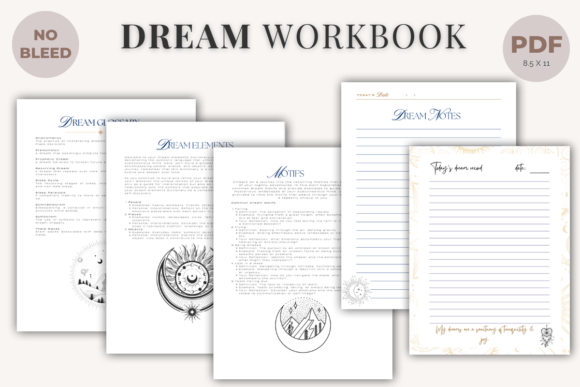
The physical product is a 156-page paperback measuring 8.5 x 11 inches, which provides ample room for handwriting without feeling cramped. Unlike many guided journals that pad the page count with empty space, this one balances structured content with generous recording areas. The opening section includes a “This Page Belongs To” personalization page and a brief but grounded introduction to dream interpretation. What follows is not a dense theoretical tome but a series of practical tools designed to be used over time.
One of the more immediately useful sections is the Symbolism Guide. Rather than presenting a rigid dream dictionary, it introduces common symbols along with potential meanings while explicitly encouraging personalized interpretations. This respects the fact that a snake can mean something entirely different to a herpetologist than to someone with a specific childhood memory. The guide sets a tone of open exploration, which is critical for building trust in one’s own associative process.
A dedicated Motif Exploration section defines and illustrates recurring dream patterns—falling, flying, being chased, appearing naked in public—and then provides space to track how often these motifs appear and the context surrounding them. Spotting a motif’s frequency can shift a dreamer’s focus from “what does this weird thing mean” to “what situation in my waking life tends to trigger this feeling of loss of control.” That reframing alone can make the workbook a valuable stress-management adjunct.
Unique Features That Encourage a Personal System
Beyond basic dream logging, the workbook includes several components that deepen engagement without overwhelming the user. The Color Symbolism pages explore how hues in dreams connect to emotional states. Because color is often one of the first details to fade upon waking, having prompts like “What was the dominant color, and how did it make you feel?” trains the brain to retain sensory data that might otherwise slip away.
The introduction of Jungian Archetypes is handled with a light touch. It briefly explains concepts like the Shadow, the Anima/Animus, and the Wise Old Man, then invites users to notice archetypal figures in their own dream narratives. No prior knowledge of analytical psychology is required. This makes the material approachable for entrepreneurs and creators who might use archetype recognition to better understand inner conflicts that influence decision-making.
Perhaps the most personalized feature is the Personal Symbols Page. Here, users are guided to identify symbols unique to their own history—a grandfather’s workshop, a specific street corner, a childhood pet—and reflect on what those represent. Over weeks, this section evolves into a self-built symbolic lexicon that no generic dream dictionary can provide. Similarly, the Dream Elements Dictionary encourages creating a glossary of people, places, and objects that recur, along with space to refine interpretations as context grows.
A dedicated Cultural Symbolism section acknowledges that a dream featuring a particular animal or ritual can carry very different connotations depending on one’s upbringing. For users with strong cultural or religious backgrounds, this is a thoughtful inclusion that prevents the misinterpretation that can arise from purely Western-centric symbol guides.
Who Gains the Most From This Workbook
This is not a one-size-fits-all promise of lucid dreaming or overnight insight. In practice, the Dream Workbook suits a few clear profiles. First, creative professionals—writers, designers, marketers—who mine their subconscious for original ideas will find the structured recollection process helps capture raw material before it evaporates. Dream fragments have inspired ad copy, character arcs, and visual concepts; having a system to harvest them makes that process far more reliable.
Therapists, coaches, and educators may also use the workbook as a client resource. It provides enough scaffolding that someone with no prior dream experience can begin without feeling lost, while remaining neutral enough to support various therapeutic modalities. The inclusion of 100 affirmations spread throughout the pages adds a gentle motivational layer without dominating the practical purpose.
For individuals navigating life transitions—career changes, relationship shifts, loss—the workbook offers a low-stakes container for processing underlying emotions. Dreams during these periods are often chaotic or emotionally charged; logging them in a consistent format can reveal the psychological arc of adaptation. The 8.5 x 11 format provides enough room to write not just the narrative but also notes on context, feelings upon waking, and later reflections, turning each entry into a mini case study of the self.
Real-World Application and Daily Usability
From a usability standpoint, the workbook’s design choices make sense for morning routines. The large trim size sits open easily on a nightstand or desk, and the pages are laid out with enough leading (spacing between lines) to accommodate varied handwriting. The structured nature of the prompts—not just “write your dream here” but targeted questions—reduces the morning grogginess barrier. A half-awake person can follow the fields rather than stare at an intimidating empty sheet.
An important practical observation: the workbook works best when treated as a cumulative resource, not a one-time fill-in. The real value accrues after 30 to 60 entries, when patterns become undeniable and the personal dictionary starts to fill out. This is where many digital apps fail—they offer searchability but lack the tactile, reflective pace of handwriting that often leads to spontaneous connections. The workbook’s paper-based format encourages slower, more deliberate thinking, which suits the subject matter.
One realistic example: a freelancer experiencing recurrent dreams about missing deadlines could use the Motif Exploration section to log each instance, then cross-reference with the Personal Symbols page to see that the “missing document” always appears in the same building. That building might turn out to be a childhood school, gently pointing toward ingrained performance anxiety rather than current workload. This kind of layered insight takes consistency, and the workbook’s structure supports that consistency through repetition of key reflective steps.
Quality, Durability, and Format Considerations
The production quality is standard for a mass-market paperback—not premium, but durable enough for daily handling. The cover is flexible and lightweight, which makes it portable despite the larger dimensions. However, users who prefer a lay-flat binding may find that the spine needs some breaking in to stay open without holding it down. A spiral-bound version would improve hands-free use, but that trade-off in shelf stability is understandable.
The 156-page count is well-judged. If used daily, it could be filled in about three to five months. This creates a natural time-bound container, making it easier to review the entire body of dreams at the end and extract long-term themes. For those who want a longer commitment, simply starting a second volume carries forward the established personal dictionary.
The 100 affirmations are integrated subtly throughout the workbook, not as a standalone gimmick. They are designed to reinforce a mindset of curiosity rather than fear, which aligns with the goal of reducing the anxiety that can accompany vivid or disturbing dreams. While affirmations can feel trite in isolation, here they serve as gentle nudges toward open-minded analysis rather than magical thinking.
Limitations and Where the Workbook Won’t Fit
If someone is looking for a rigorous academic text on oneirology or depth psychology, this workbook will feel introductory. It intentionally avoids dense theory in favor of practical application. The symbol guide, while helpful, cannot replace the nuanced interpretation that might come from years of study or clinical work. The archetypes section, too, is simplified; a Jungian analyst might wish for more depth, but the target audience likely will not.
Another limitation is that the workbook is rooted in a broadly Western psychological perspective, despite the cultural symbolism section. Users from indigenous or non-Western backgrounds where dream interpretation carries spiritual or communal weight may need to adapt the framework. The space for personal meaning does offset this to some degree, but the underlying approach remains individual-centric rather than collective or ancestral.
Digitally native users who rely on searchability and keyword tagging might find a paper journal initially less efficient. The trade-off is depth versus speed. Retrieving a specific dream from three months ago means flipping pages rather than typing a search term, but that manual search can sometimes re-surface forgotten dreams that prove relevant. It’s a different mode of engagement, not a defect.
Building a Long-Term Practice With the Dream Workbook
The most successful use of this resource tends to follow a simple cadence: record immediately upon waking, briefly note the dominant feeling and any strong symbols, then once a week revisit the motif and archetypes sections to see what has accumulated. Those weekly reviews transform the workbook from a daily log into a reflective tool that can highlight subtle shifts in emotional preoccupation.
For bloggers, publishers, or content creators, the compiled material can become a valuable source of raw content. Dream symbolism can inspire articles, social media narratives, or thematic series. Having it organized by motif and personal meaning makes extraction far easier than scattered phone notes or audio memos. The Dream Workbook essentially structures what might otherwise be an unreliable creative well.
Small business owners or entrepreneurs under chronic stress may discover that dream content correlates with decision fatigue or unvoiced concerns. A recurring dream of a building collapsing, for instance, might coincide with a period of ignoring operational red flags. By paying attention, the workbook serves as an early warning system that prompts conscious action rather than staying buried in the subconscious.
Final Observations on Practical Value
Evaluated as a tool rather than a novelty, the Dream Workbook earns its place on a desk or nightstand by respecting the user’s intelligence and capacity for self-guided discovery. It does not overpromise; it simply organizes a process that many people want to adopt but lack the discipline to build from scratch. The combination of educational references, open-ended prompts, and dedicated space for personal interpretation makes it a reliable scaffold for long-term dream work.
Whether used for creative sourcing, emotional processing, or personal development, the workbook’s strength is its quiet insistence on consistency. By making the intangible tangible—one entry at a time—it transforms a sporadic curiosity into a practical skill that sharpens observation, empathy, and self-awareness. For professionals navigating complex inner landscapes, that’s not just an interesting exercise; it’s a sustainable edge.